Your agency's actual job isn't to drop the CPA.
Most agencies act like it is, though. The brief comes in with a metric attached and everyone just... optimizes toward it. And then they wonder why every paid search ad looks the same, every Meta creative looks the same, and the only way to win is to outbid somebody.
Optimization is a race to identical.
A CMO I respect talked about what big brands actually want from agencies, and the thing that stuck with me was this: they want a culture factory. Someone who understands the connection between the consumer or business culture they're selling into, and can bring that understanding TO the brand. Not the other way around.
That's a completely different job than "hit the number."
A financial brand doesn't just need cheaper cost per acquisition. They need someone who understands that the 18-year-old who gets their direct deposit a day early and earns points at the places they were already going to spend money anyway? That kid is a customer for decades. The brand knows how to build the financial engine. They don't know how that kid works.
THAT is the thing you bring: the ability to walk into a room and say, here is who your customer actually is, here is what they actually care about, and here is why your current brief is optimizing you away from them.
That's POV, that's ROU, and it's the only thing AI can't manufacture and a client can't figure out on their own.
If you are running campaigns without that, you are just another pair of hands pointing at a dashboard.
Writings · Notes · Signals
Tim Kilroy
Hi. I'm Tim. This is a regularly updated stream of what I post to socials. It's usually about agencies, entrepreneurship & me being a little sassy. Read more at https://timkilroy.com/blog or https://agencyinnercircle.com
2026
50 entries
-
-
 I am super excited to be part of 4As Expert Network! Don't know what aaaa.org is? It's the American Association of Advertising Agencies. It's a trade organization, a great networking place & a place to learn - they have great courses, huge treasure troves of data & great events! (And somehow I convinced them that I am expert enough that their members can learn from! I totally fooled 'em...)
 -
I am super excited to be part of 4As Expert Network! Don't know what aaaa.org is? It's the American Association of Advertising Agencies. @https://www.linkedin.com/company/4as/posts/?feedView=all It's a trade organization, a great networking place & a place to learn - they have great courses, huge treasure troves of data & great events! (And somehow I convinced them that I am expert enough that their members can learn from! I totally fooled 'em...)
-
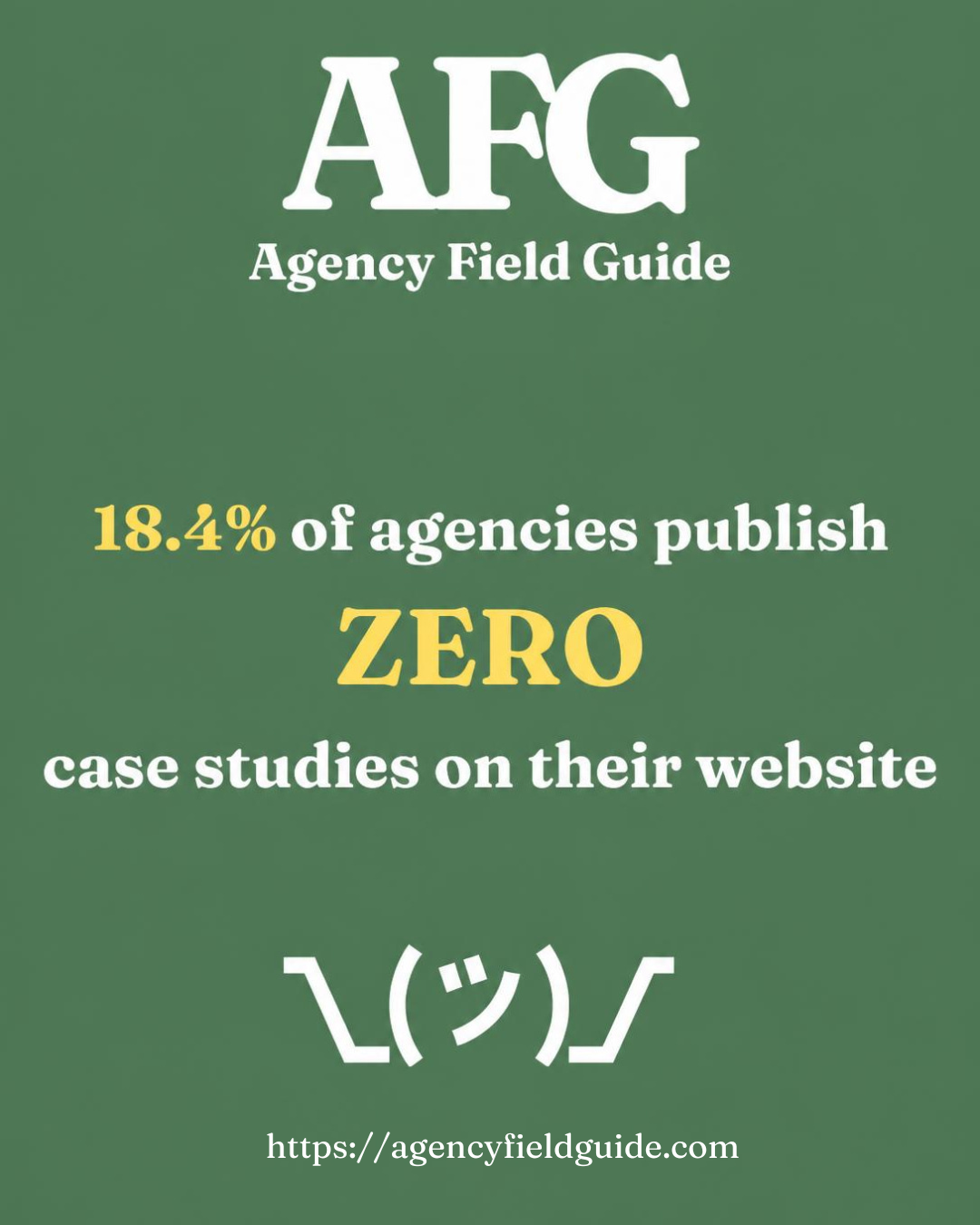
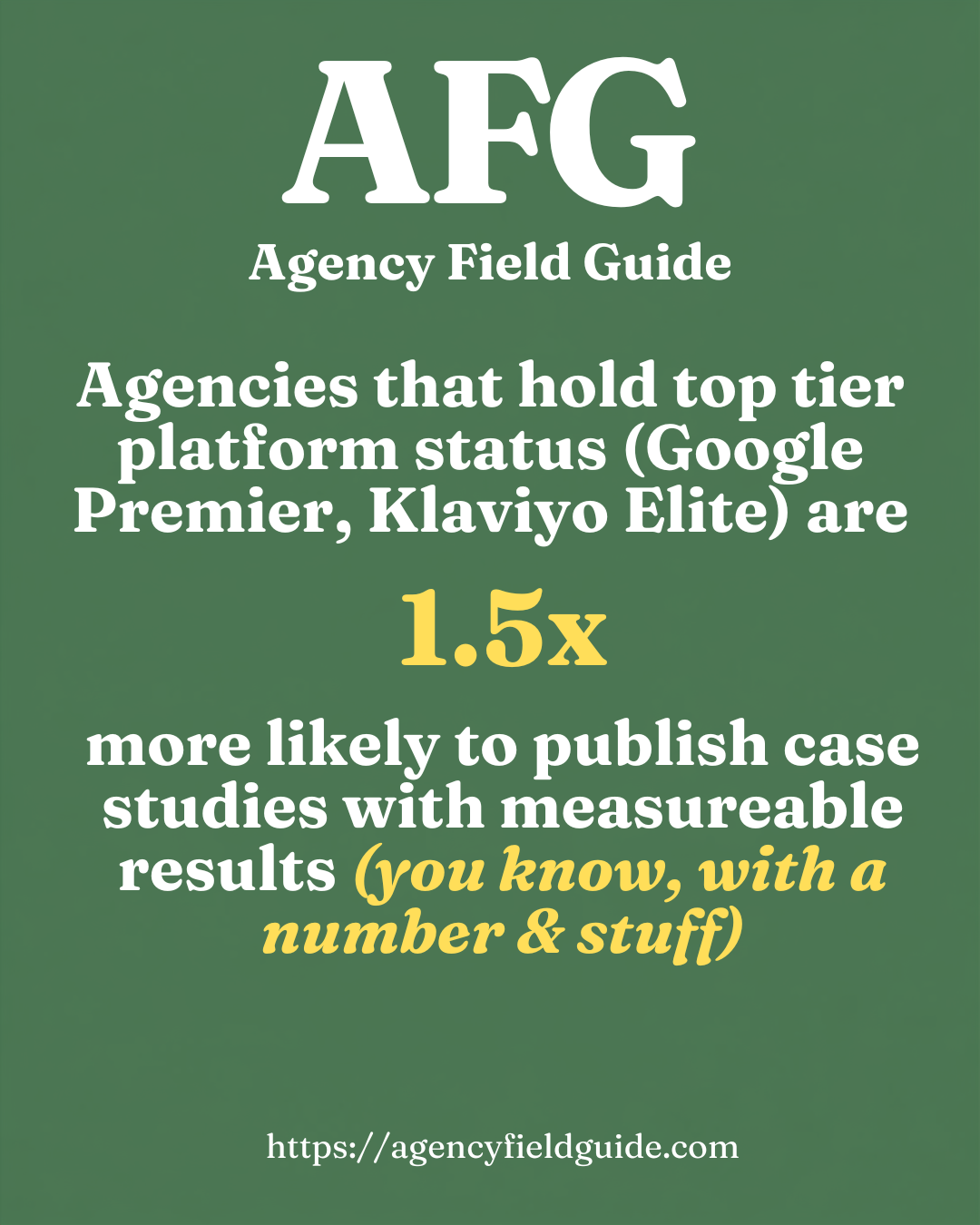
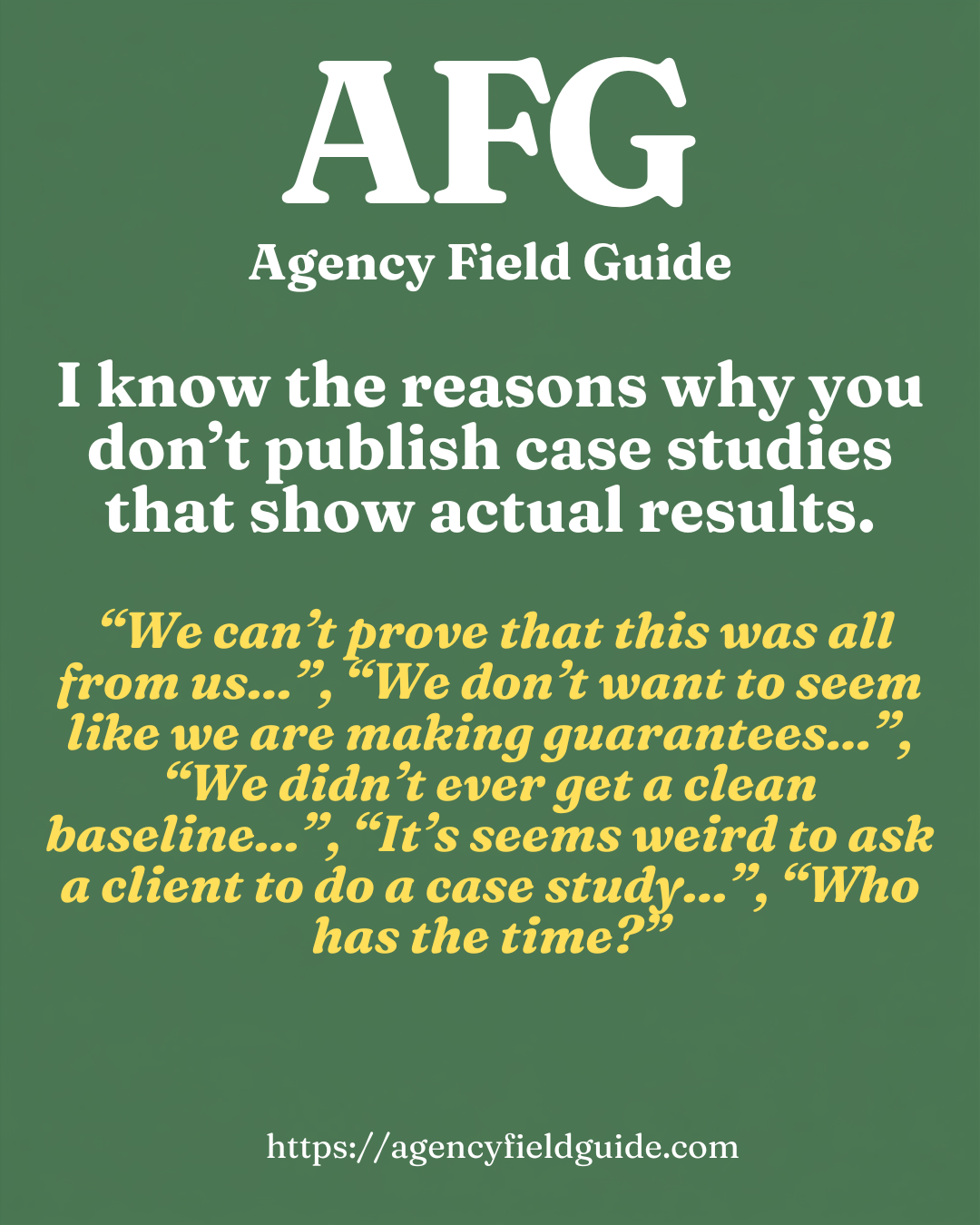
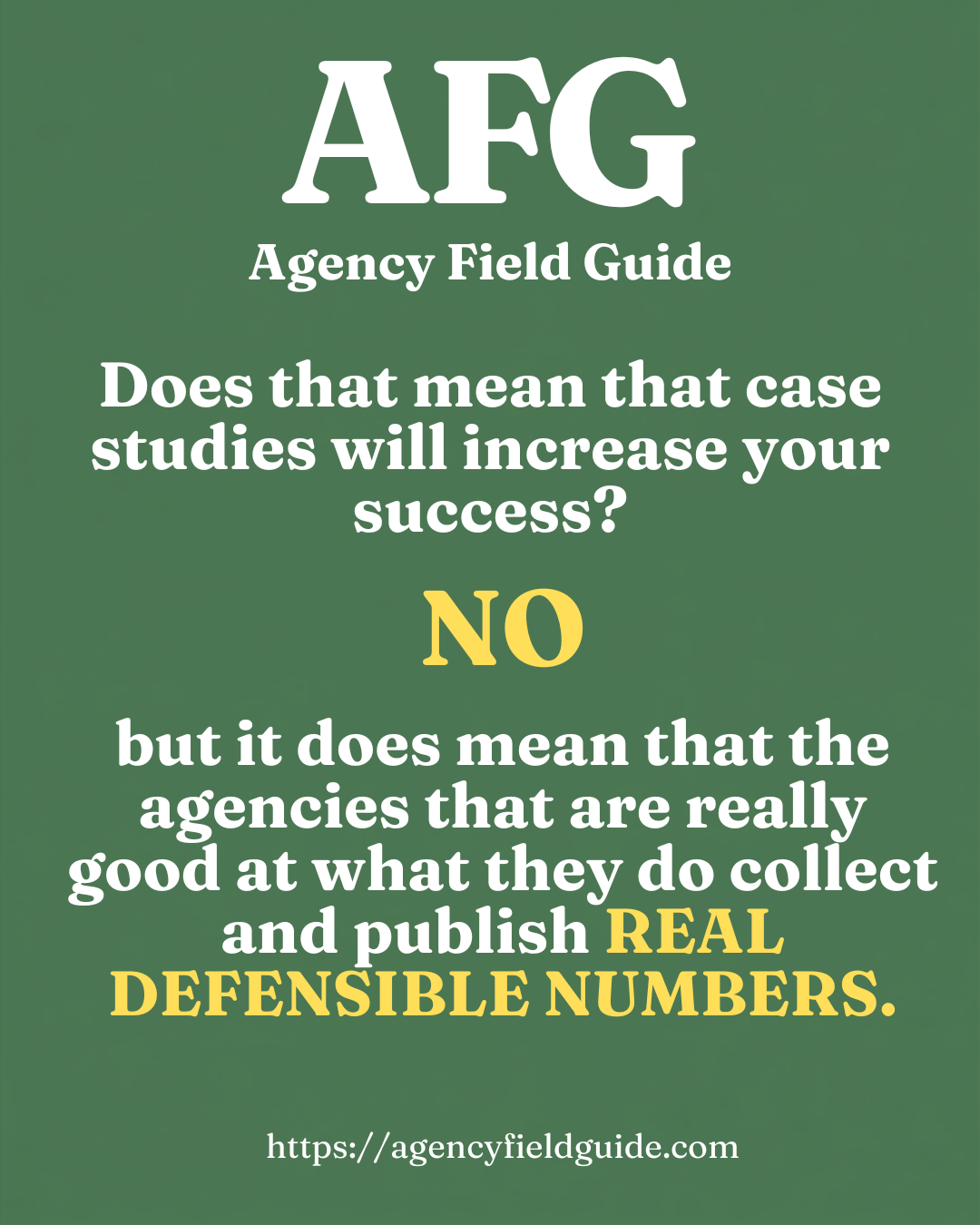 18.4% of agencies don't publish case studies on their website. (Via AgencyFieldGuide (.) com) Agencies that do publish case studies with actual numbers and results in them are 1.5 times as likely as to be a top-tier partner on a platform partner list like Google Partners or Klaviyo Partners, etc. Does this mean that publishing case studies will make you a better agency? Hell no. Does it mean that agencies that measure their work and know what constitutes a win are way more likely to be good at what they do? Yup. I know why you probably don't publish case studies with numbers in them. You are afraid of being braggy, or you are not sure that number is defensible, or the worst possible excuse: "I just don't have the time." F that. You run a marketing agency. Use the proof & power of what you do in order to market yourself.
 -
The biggest unlock in business isn’t another system, strategy, or framework. It’s understanding yourself. What am I genuinely good at? What am I confident doing? What am I willing to tolerate? And just as importantly what simply isn’t right for me? You start recognizing "this is something my business would do" and maybe more importantly "this is something it wouldn’t." The yield you get from alignment is what I call ROU - Return on Understanding. Because the better you understand yourself, the easier it becomes to build a business that actually fits who you are instead of constantly forcing yourself into someone else’s model. I went deeper into this idea in my conversation with Jaime Ellithorpe of @https://www.linkedin.com/company/540-strategies/ Full podcast below hear the whole conversation.
-
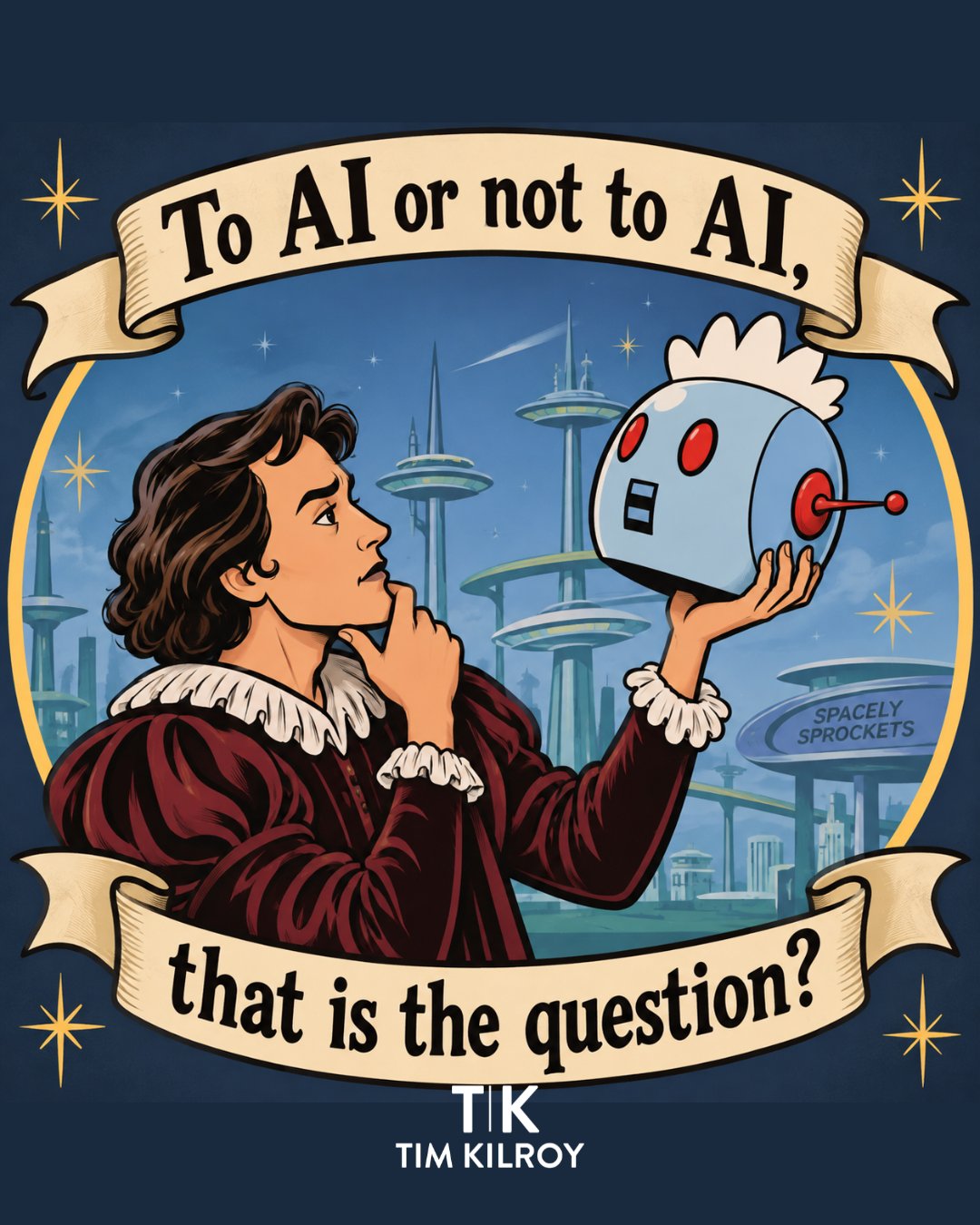 Here is the AI trap I see agencies fall into - they use AI to automate existing processes rather than build processes around what AI can do better. Cold outreach is a great example - "personalizing" an email is a way to say "I did some research on you." It doesn't really add any value to have AI say "Hey - I noticed that thing you did!" The prospect already KNOWS that stuff. It doesn't really add value to take meaningless personalization and scale it to tens or hundreds of thousands of unwilling recipients. What could you do with AI that's better than using some bullshit personalization? Maybe: 1. You could use AI to take your list of potentials and cull any that don't have a certain number of real similarities to your best clients...so instead of sending more spam, you send better fit outreach. 2. You could use AI to pull out all market needs from your sales calls and find evidence of those market needs in a prospects...again, using AI to send fewer, not more, emails. 3. You could use AI to create a prospect specific landing page that shows the connection between that specific prospect and your service... There are so many more interesting and high-impact things you can do with AI, rather than just use all of this power to scale shitty, undifferentiated crap
 -
 An agency I coach built a multi-7-figure ecommerce business for their client from scratch. Last month the client CEO emailed - she was shutting it down. Why? Her dashboard said traffic down & sales not growing. A failed experiment in her mind. What her dashboard didn't say - margins up, conversion up, AOV up, $1.3M in annual profit and accelerating. The agency knew all of it. It just wasn't in the weekly report. Selling opportunity is easy. You show the future, the client imagines it, they run toward it. Proving value is the work that shows your impact. Your client has forgotten every decision you've made and every adjustment you created. If you don't tell that story, your work is nothing by a number on a report. Do the work
 -
 I hired a salesperson, talked at him for two hours, handed him a PowerPoint and unlimited minutes on his cell phone. In 4 months, he didn't close a deal. I decided he sucked. He didn't suck. He said he did not have my stories or context in his head, and he was right. I sucked at building a sales process he could succeed with... A sales process is not an SOP with a CRM taped to it, it is your agency lore. Learn to make sales an agency function that you can manage.
 -
 Stop delivering and your client screams today. Stop paying taxes and the IRS screams eventually. Stop marketing and absolutely nothing happens, which is the terrifying part. My agency went quiet for ten weeks once, and my CAC went from $3,800 to $10K! Only 21 percent of agencies have anyone marketing the agency, and only 14 percent report a healthy pipeline. That is not a coincidence. You've got to create a visibility function in your agency. Dig in via the bio.
 -
 When shit hits the fan, sometimes you, the intrepid agency leader, jumps into a client call saves the day! You feel like a hero. You also just taught your client to escalate past your account manager forever. You aren't a hero who saves your agency, you are more like the composer of the symphony that is your agency. And composers don't hum a melody and hope that the orchestra remembers it. The create a score & an arrangement, and then let the players play. In this case, the players are your team...learn to be the composer, not the 1st violinist. Read the whole thing.
 -
 They say revenue is vanity and profit is sanity. The way to get sane is one flipped equation. Instead of running your biz from this formula: (Revenue-expenses) = Profit Run your agency from this better formula: (Sales - Profit) = Expenses you can afford. Your job as the agency CEO isn't making money, it's allocating it.
 -
 Admin Hell Sucking really hard at admin & delegation killed my first agency, not the market. The Eisenhower Matrix is a great management tool to help you prioritize what matters. The Kilroy Matrix tells you if you (as the CEO) should even touch it. RACI turns the whole mess into a function somebody else can run. You are the architect, not the builder. Link in bio.
 -
 "Never mind, I'll do it." Those five words have killed more agency growth than any recession. I learned the fix from my brother-in-law, who runs a box factory. He taught me that your output is somebody else's input, and that you fix the line at the loading dock, not at the end. Your team does not need more instructions, they need context. Great chefs do not hover over the mirepoix. They teach what good looks like, then they let the kitchen cook. Read the whole thing in the bio.
 -
 CEO does not stand for Chores, Everyday tasks and Overwhelming to-do lists. If you are doing grunt work where you add no CEO-level value, you aren't running your agency, you are working at it. Just think - the CEO of your bank doesn't make change for a $20 at the teller window. They could...but that isn't their job! Agency activities that get done by the team are deliverables and invoices and client calls. Agency business functions that CEOs MANAGE are delivery, account management, sales, marketing and admin. Read the full issue. Link in bio or below.
 -
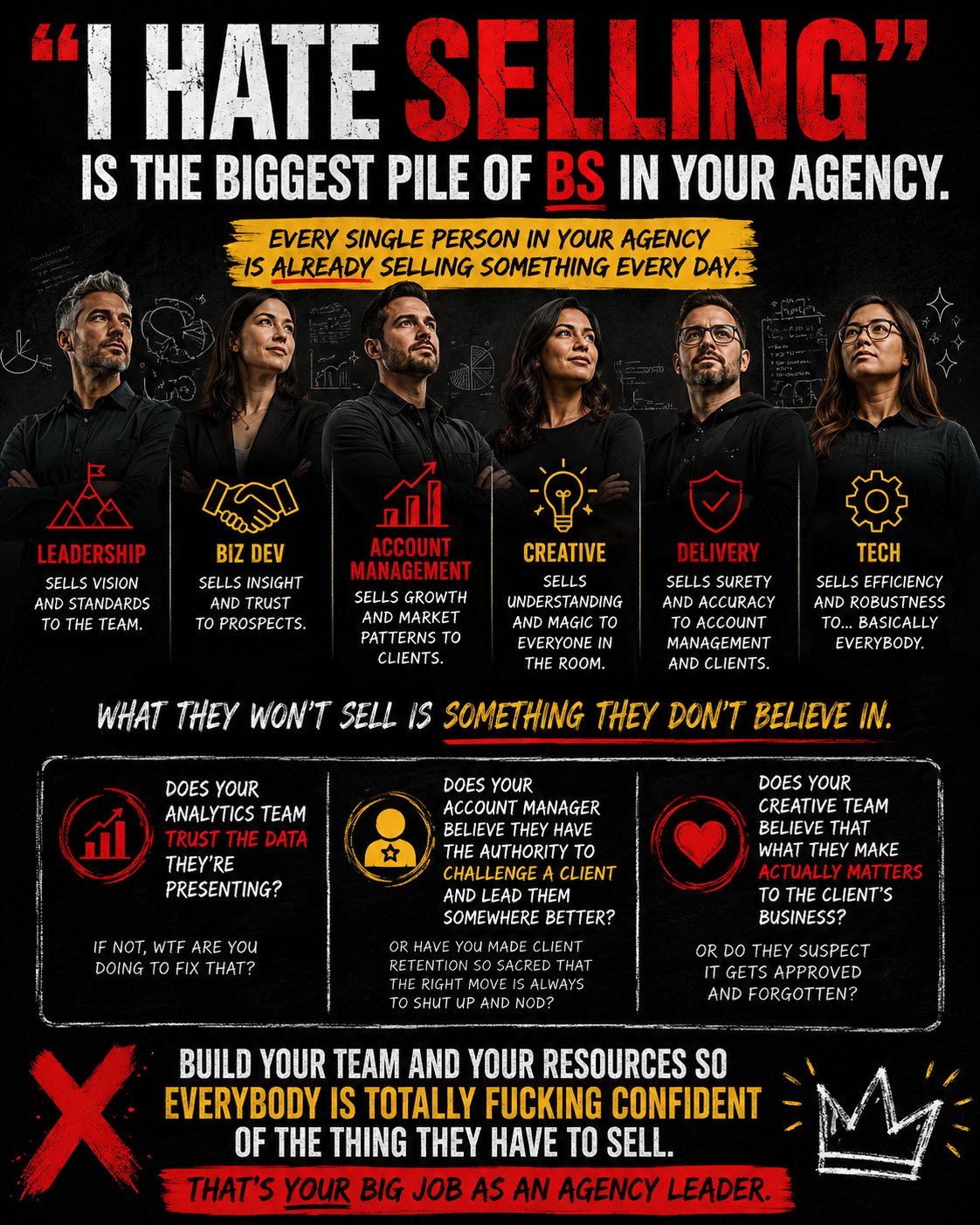 "I hate selling" is the biggest pile of BS in your agency. Every single person in your agency is already selling something every day. Leadership sells vision and standards to the team. Biz dev sells insight and trust to prospects. Account management sells growth and market patterns to clients. Creative sells understanding and magic to everyone in the room. Delivery sells surety and accuracy to account management and clients. Tech sells efficiency and robustness to... basically everybody. What they won't sell is something they don't believe in. So if your team isn't selling their own work, their own value & the value of your team and agency to anyone who will listen, you've got some shit to fix: Does your analytics team trust the data they're presenting? If not, WTF are you doing to fix that? Does your account manager believe they have the authority to challenge a client and lead them somewhere better? Or have you made client retention so sacred that the right move is always to shut up and nod? Does your creative team believe that what they make actually matters to the client's business? Or do they suspect it gets approved and forgotten? Build your team and your resources so everybody is TOTALLY FUCKING CONFIDENT of the thing they have to sell. That's your big job as an agency leader.
 -
DEMANDOS AGENCY WEBSITE REWRITE OF THE DAY AGENCY: Award-winning 6 year old ecom agency. They seem to be VERY good at what they do - "Partner of the Year" and that sort of stuff from a VERY big platform. CURRENT HEADLINE: YOUR E-COMMERCE MARKETING PARTNER Ugh - this is as exciting as oatmeal. It's good that they let you know they do e-commerce, but I would guess that out of the 71,000 marketing agencies in the US, at least 48K of them could say the same thing. CURRENT SUBHEAD: As an extension of your team, we develop and execute custom marketing strategies that scale digital brands. We are reaching maximum density for words that sound like YAFA (Yet Another Fucking Agency) PLUS MORE PASTY COPY: → "data-backed strategy and full-service, expert execution" (strategy sounds Harvard Business School smart, right?) → "Strategy-Driven Decision Making" (yay, more strategy! are there vibes-driven strategies? asking for a friend...) → "we deliver results driven by strategy" (ah, strategic results - must be a relative of strategy-driven decisions, obvi) → "game-changing e-commerce marketing services" (thank gawd we are changing the game & not saying strategy again) You know what's cuckoo? They've driven $100mm in client revenue. They deliver big but sound EXACTLY like everyone else. Here is the DemandOS rewrite: HEADLINE: 100 MILLION REASONS TO PICK [AGENCY NAME] SUBHEADER: We've driven $100m in revenue growth for our clients. That's not an accident. Rapid, profitable growth isn't just doubling down on one channel; it's about knowing how your brand makes money. We work across channels - web development, SEO, paid media, marketplaces & more - to deploy the smarts learned & earned from working with 250+ ecommerce brands. Want to be part of the next $100m? Get in touch. What do you think about the DemandOS Rewrite of the Day?
-
 WTF - after today only 17 Mondays left in the year. Hey, didya know that there are over 71,000 marketing agencies in the US? In 2025, the average agency grew revenue 7.5% vs a 10 yr rate of 12% annual growth (that's a 38% drop) & net profit dropped about 14% On top of all that, only 14% of agency owners say their pipeline is "healthy" & 88% of agencies say biz is "meh" or "struggling" But, only 17 weeks left before your 2026 P&L is set in stone. You have to figure out how to grow, make more profit & stand out vs 71K competitors over the next 17 weeks.... Here are 4 ways to turn this short biz dev from WTF to Wow, That's Fantastic: 1. RETENTION: Keep EVERY client you can. Retention will be your #1 profit lever for the rest of the year. 2. ICP: Sharpen your ICP ASAP. "North American Fashion Brands, <$10mm & >$50mm revenue, with target audience of women 35+" beats "ecommerce fashion brand" every time. It makes your targeting & messaging way more relevant. 3. ATTENTION: You have 71,000+ direct or indirect competitors. What are you doing to draw attention to yourself? Referrals aren't a dependable answer. Cold email ain't gonna cut it. You've got to think bigger...webinar/podcast guesting + clipping, build a fantastic lead magnet that gives real value & gives you insight into the potential lead, create a front end offer that is easy to say yes to & ties to your service (eg, if you run ads, do a tracking audit, CAPI check, GA Audit & set up Triple Whale for $2K and now you have insight into how their ads are working...). Don't be shy about promoting any and all of this stuff. 4. UNDERSTAND: Your market is in the same spot you are - racing to the end of the year. So know that, be proactive & responsive. Take responsibility, show your value & get to a yes/no as quickly as you can. Don't waste time (yours or theirs).
 -
WTF - after today only 17 Mondays left in the year. Hey, didya know that there are over 71,000 marketing agencies in the US? In 2025, the average agency grew revenue 7.5% vs a 10 yr rate of 12% annual growth (that's a 38% drop) & net profit dropped about 14% (data via @https://www.linkedin.com/company/promethean-research) On top of all that, via @https://www.linkedin.com/company/sparktoro/, only 14% of agency owners say their pipeline is "healthy" & 88% of agencies say biz is "meh" or "struggling" But, only 17 weeks left before your 2026 P&L is set in stone. You have to figure out how to grow, make more profit & stand out vs 71K competitors over the next 17 weeks.... Here are 4 ways to turn this short biz dev from WTF to Wow, That's Fantastic: 1. RETENTION: Keep EVERY client you can. Retention will be your #1 profit lever for the rest of the year. 2. ICP: Sharpen your ICP ASAP. "North American Fashion Brands, <$10mm & >$50mm revenue, with target audience of women 35+" beats "ecommerce fashion brand" every time. It makes your targeting & messaging way more relevant. 3. ATTENTION: You have 71,000+ direct or indirect competitors. What are you doing to draw attention to yourself? Referrals aren't a dependable answer. Cold email ain't gonna cut it. You've got to think bigger...webinar/podcast guesting + clipping, build a fantastic lead magnet that gives real value & gives you insight into the potential lead, create a front end offer that is easy to say yes to & ties to your service (eg, if you run ads, do a tracking audit, CAPI check, GA Audit & set up Triple Whale for $2K and now you have insight into how their ads are working...). Don't be shy about promoting any and all of this stuff. 4. UNDERSTAND: Your market is in the same spot you are - racing to the end of the year. So know that, be proactive & responsive. Take responsibility, show your value & get to a yes/no as quickly as you can. Don't waste time (yours or theirs).
-
 Team-led marketing is probably the most ignored asset in your agency. You actually have a team of "creators" working for you. I don't mean your media buyer is going to suddenly become a personal brand machine, or your account manager is going to become an influencer. I mean something simpler and way higher impact. Your team already has a point of view. They've got experience. They've absorbed your style, your thinking, your way of seeing client problems. AND they've got their own take on all of it. So why the flip are you carrying the whole marketing & visibility thing yourself? Marketing, awareness & sales OUGHT TO BE A TEAM SPORT. Your positioning and experience (I call this VVV - Vibes, Vision & Values) you talk about on your sales calls belongs to the whole agency, not just you. The insight you bring to a discovery call is the collective intelligence of every person on your team. When you are the only one making noise, it's way harder to hear. So, turn that solo singer songwriter thing you've got going on into a full band: 1. Identify 2 or 3 people on your team who have a clear POV on something relevant to your ICP. (Every agency has at least 2 or 3 - I promise.) 2. Sit down with each of them for 20 minutes and let them throw up on you about what clients don't understand. Your job is to listen. 3. Challenge them to make a social post about it in their own voice, not the agency voice or some version of yours. It needs to be authentic to them and their experience, but it can share the vibe, vision, and values that your agency has inherently. 4. Those teammates with a point of view have a different audience than you do. They might reach the creative director of a brand or the UI/UX leader at a SaaS company, or somebody that you are not connected to because they are not a CEO or a decision maker. 5. Then have each one of those people bring their post to other people on the team and say, "Hey, what do you think about it from your perspective?" Suddenly, you've got some core message that's evocative of your vibes, vision, and values being repeated from the perspective of a media buyer, from a biz dev person, from a technologist, from a copywriter, from a designer, from whomever on your team. Those disparate connections & engagements will bubble up and become business from places that you could never reach. You aren't the only brilliant one in your agency. Keep singing your song. but let those other rockstars shine.
 -
 Did you know only 14% of agencies have a healthy pipeline? (Via SparkToro) The agencies I see scrambling in Q4 are scrambling for the same reason they scrambled in April: 1. Fuzzy ICP 2. Positioning that is sharp as a bowling ball 3. No clear way to get any attention. 4. No way to turn attention into clients. You probably ought to have a plan to fix 1,2,3 & 4, right?
 -
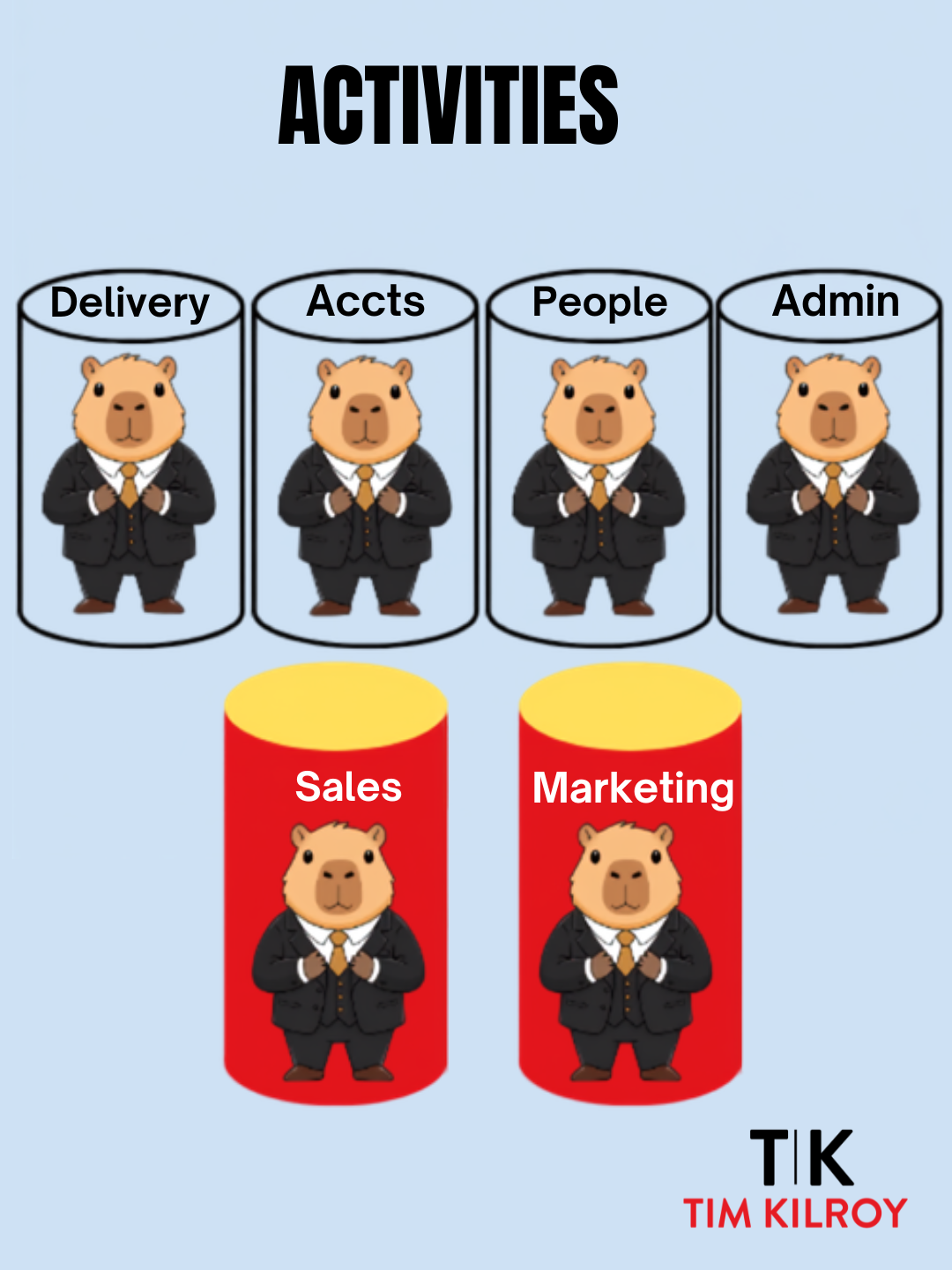
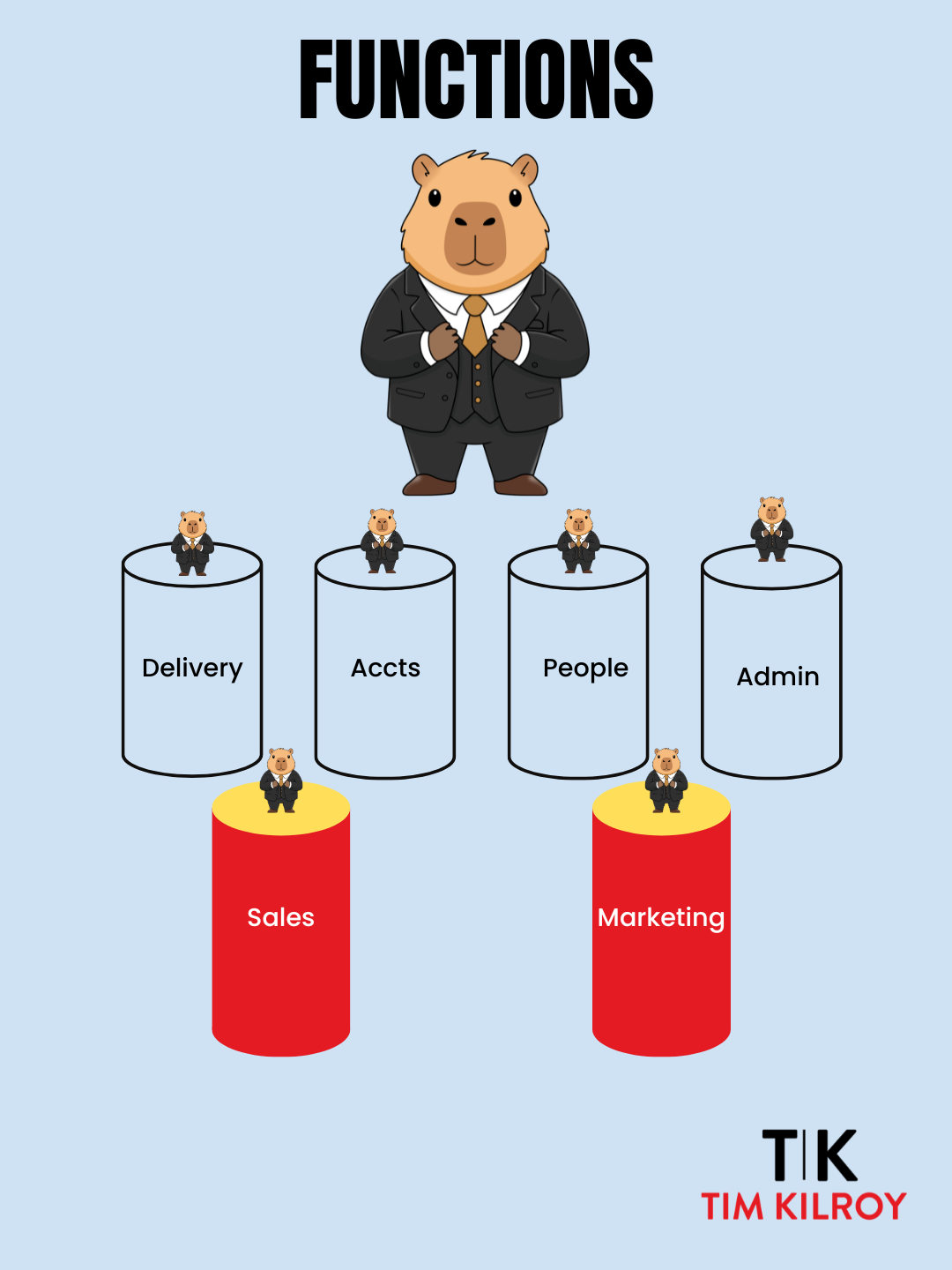 THERE'S A HUGE FREAKIN' DIFFERENCE BETWEEN ACTIVITIES & FUNCTIONS Activities are the stuff your agency DOES - sending the invoice, running the client meeting, building the deliverable. Functions are the shit you MANAGE - client delivery, account management, sales, marketing, admin. Most founder led agencies smash those two things together until they are the same flippin' thing - and almost everything (function or activity) involves your eyeballs, fingers or other body parts. That's why YOUR agency starts feeling like a shitty job with a wanker for a boss. This isn't how CEO's role. Jamie Dimon (CEO of JPMorgan Chase) couldn't turn your $100 into five $20s at a Chase branch. He's not incapable of handling high finance like that, but that just isn't his job. Your job is to initially define the activities (what they are and what a great outcome looks like) for your team. Then you MANAGE the function it belongs to. ACTIVITIES are work. FUNCTIONS are leadership. Want all the details? https://www.agencyinnercircle.com/p/agency-inner-circle-178
 -
 AI DRIVEL O'THE DAY: I responded to a LinkedIn nMail ad titled "Partnership Ideas". I knew it was an ad. I just wanted to find out what would happen when I responded. In 2 seconds, I got a friendly AI-powered response that crammed in a shit-ton of options: 1. We will be your white label partner. 2. Send us your overflow leads and we will pay you handsomely(?). 3. We want to buy small agencies - do you want to sell? OK - it was an ad...but here are 3 big issues: 1. I don't run an agency, so the whole thing is moot. 2. When I have referrals to give, I give them to current clients, past clients and friends. Why would I give them to a stranger who will pay me 5%? 3. See #1 And before you say the bot is the problem, it's not - the bot did it's job, burned those tokens, and enthusiastically made me an irrelevant offer. The agency owner decided that cramming three completely different asks into one automated message was a reasonable way to start a relationship. It's so fucking not. I think we ought to come at conversations with respect, humility, grace, a modicum of actual curiosity about who you are talking to... If you have nothing real to say and no actual interest in who you're talking to, please, just shut the fuck up.
 -
AI DRIVEL O'THE DAY: I responded to an InMail ad titled "Partnership Ideas". I knew it was an ad. I just wanted to find out what would happen when I responded. In 2 seconds, I got a friendly AI-powered response that crammed in a shit-ton of options: 1. We will be your white label partner. 2. Send us your overflow leads and we will pay you handsomely(?). 3. We want to buy small agencies - do you want to sell? OK - it was an ad...but here are 3 big issues: 1. I don't run an agency, so the whole thing is moot. 2. When I have referrals to give, I give them to current clients, past clients and friends. Why would I give them to a stranger who will pay me 5%? 3. See #1 And before you say the bot is the problem, it's not - the bot did it's job, burned those tokens, and enthusiastically made me an irrelevant offer. The agency owner decided that cramming three completely different asks into one automated message was a reasonable way to start a relationship. It's so fucking not. I think we ought to come at conversations with respect, humility, grace, a modicum of actual curiosity about who you are talking to... If you have nothing real to say and no actual interest in who you're talking to, please, just shut the fuck up.
-
 Your agency's marketing is broken because you've been building it from inside your own agency! You market what's closest to you, not what your clients actually buy. You stand in the middle of your own operation all day, so of course that's what comes out of your mouth. The awards. The proprietary process with the little trademark symbol. The tech stack. The team you built and genuinely love. I can say this with some authority, because I've sat on the other side of that table. I've been a C-level buyer and I've run multiple agency searches for brands. I've read the decks. Here's the truth - nobody gives a shit about slide four and your methodology. They're trying to work out whether you understand the mess they're in, and whether having you around is going to make their life better or worse. Awards, tenure, tech, methodology, headcount. That's proof, and proof matters, but proof is a tiebreaker. It's what a buyer verifies after they've already decided they want you. Leading with it is like a restaurant handing you the health inspection score instead of a menu. Agencies get VVV twisted every time. Owners hear "express your Vibes, Vision and Values" and immediately produce a culture slide. Team photos from the holiday party. A word cloud with "curious" and "scrappy" in it. Core values written in the first person plural, which is the tell, because the client is not in that "we." Your Vibes, Vision and Values are the most outward-facing thing your agency owns, as long as you state them correctly: Vibes are what it feels like to BE your client. Do they get told the truth on Tuesday, or at the QBR six weeks later? Do they leave your calls lighter or heavier? That's a vibe. Ping pong is not a vibe. Vision is what you see about their market that they can't see from where they're standing. A point of view about their problem, specific enough that it could be wrong. If your vision could be pasted onto any client in any category, you don't have one. Values are what you refuse to do, to them and for them. The scope you won't take. The channel you'll talk them out of. The client you fired. Values are a promise about their money and their time, not a poster in the break room. Every one of those points at the client. Inside-out marketing describes your apparatus. Your VVV describes the relationship the buyer is about to be in. Your culture only reaches the client through the work and through the way your people behave when they're in the room. Put it on a slide and it's decor. Let it show up as an account lead who tells a client an uncomfortable truth in week two, and the client feels it without either of you ever saying the word "culture." Same goes for your process. The buyer isn't purchasing your workflow. They're purchasing what your workflow makes possible, which is the sensation of not having to worry about this anymore. Doesn't matter what's on your rate card. You sell relief.
 -
 So, I've been using this great tool - @DemandBird from @AlexBoyd and @MacMartine. It is a social posting and repurposing tool - it's easy to use, works super well (and has a cool teams feature for those of you that want to do the team-driven social first approach that I espouse in #DemandOS). But what I really love is this cool "all posts aggregated" page they make (mine is in comments). It isn't revolutionary, but in a team setting, seeing all of the stuff your agency puts out can be so huge for inspiration!
 -
 Agency stuck at $70K/month for six months. They think it's a lead problem. Wrong. Their positioning is "whatever digital marketing you need, we do," so they can't say no to anyone. They stay on the freelancer marketplace, sign bad-fit clients, burn the team out, churn at 2 months. Repeat. "More leads" feels like the fix. Pouring leads into that machine just turns the churn rate up to 11. Fix the order of operations: Know who you are. Keep the clients you've got. Then go get more.
 -
 Did y'all know that agency founders are magical? It's true. They all have this thing called "Founder Magic". It's a superpower that can accelerate your agency like a Lucid Sapphire (1.86 seconds 0-60 mph) in the early days. But it can seriously slow down you agency growth when that magical founder starts to pull away from the day to day. In this Motor Trend Car of the Year award-winning issue of The Agency Inner Circle, you are going to learn how: 1. The way that you sell as a founder isn't transferrable to someone else (without some serious work) - no matter how good they are at sales. 2. Your agency brand is trapped in your head. If you don't let it out, your team is going to forget the right direction. (And your market is gonna forget you too) 3. Why INVESTING your founder magic is imperative. 4. We talk a little bit about why we built SalesOS I bet there's other nifty stuff in there but I don't wanna spoil the whole thing. BTW, if anyone has a Lucid Sapphire they aren't using any more and would like to get me a belated birthday gift, you know where to find me.
 -
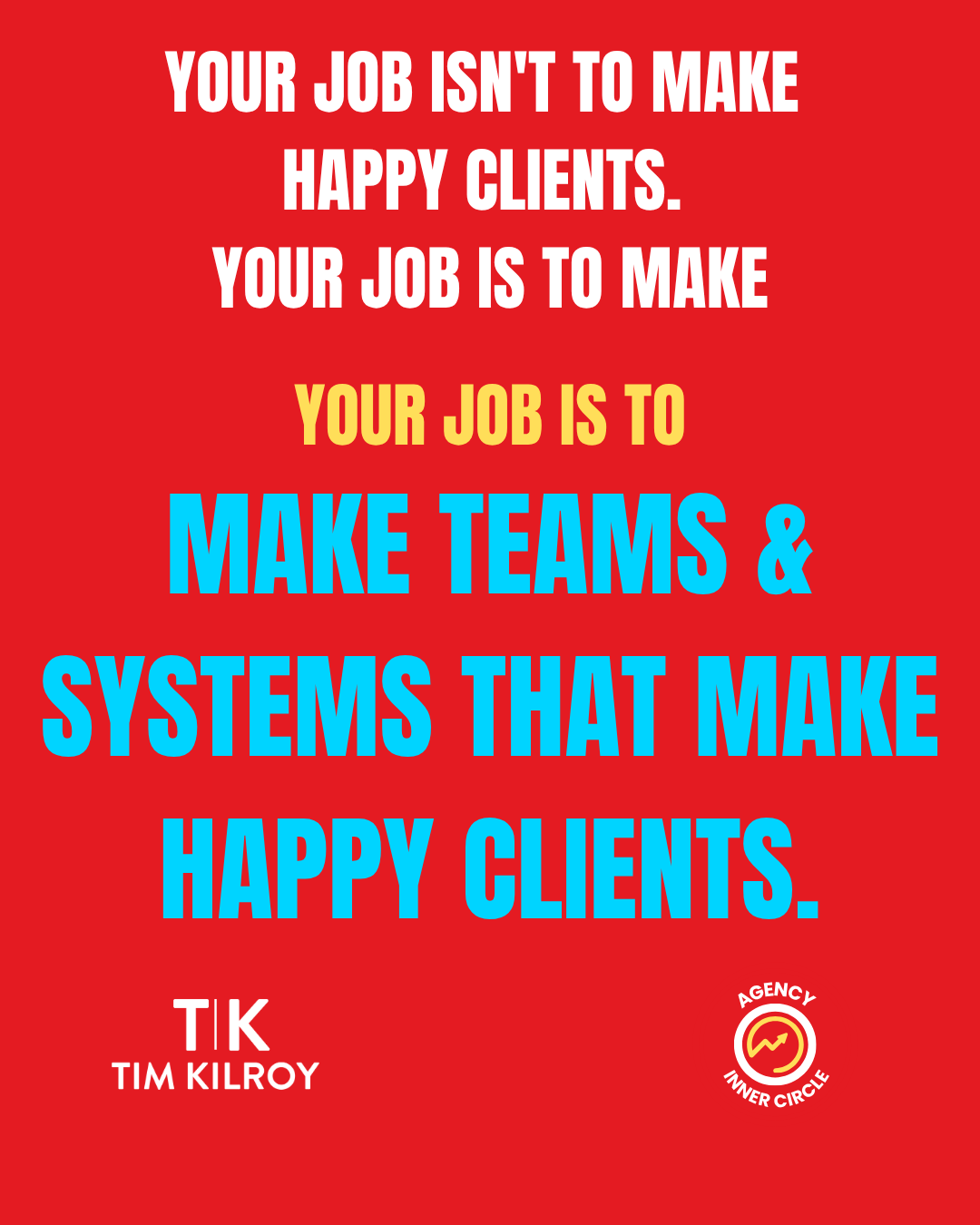 YOUR JOB ISN'T TO MAKE HAPPY CLIENTS. YOUR JOB IS TO MAKE TEAMS & SYSTEMS THAT MAKE HAPPY CLIENTS. I said that on a podcast back in 2018. I had a call this week with an agency owner who has built something that they genuinely hate. They are the bottleneck, the accelerator, and the single source of truth for every question from a prospect, client or staff. Every decision routes through them. Every client relationship is based on their expertise. Every piece of content sounds like them because it IS them. I know why they do this - they are afraid someone else is going to fuck it up. I guarantee that they will fuck it up, at least once or twice. There's nothing you can do to change that learning curve - but refusing to help your team learn that curve is forcing you to build a an agency that you hate. I've got a fix - I call it UNSCALE. UNSCALE doesn't mean your agency does fewer things. It means YOU do fewer things. You let the experts on your team lead. You let them put their faces on the content and the social and the YouTube so that prospects can actually see the people they are going to work with. You let someone else run the sales process. You stop being the single point of failure and start being the architect of a thing that runs. Most agency owners I talk to say they want to build a $10mm or $20mm ot $100mm agency. When I dig in a little, what they actually want is cash and autonomy. You don't need a huge team to build an agency that allows you to manage the agency while your team operates the agency (cuz that's what you really want...after 30 year in this biz, you gotta trust me on this one...). Ping me & we can maybe talk about what UNSCALE looks like for you...
 -
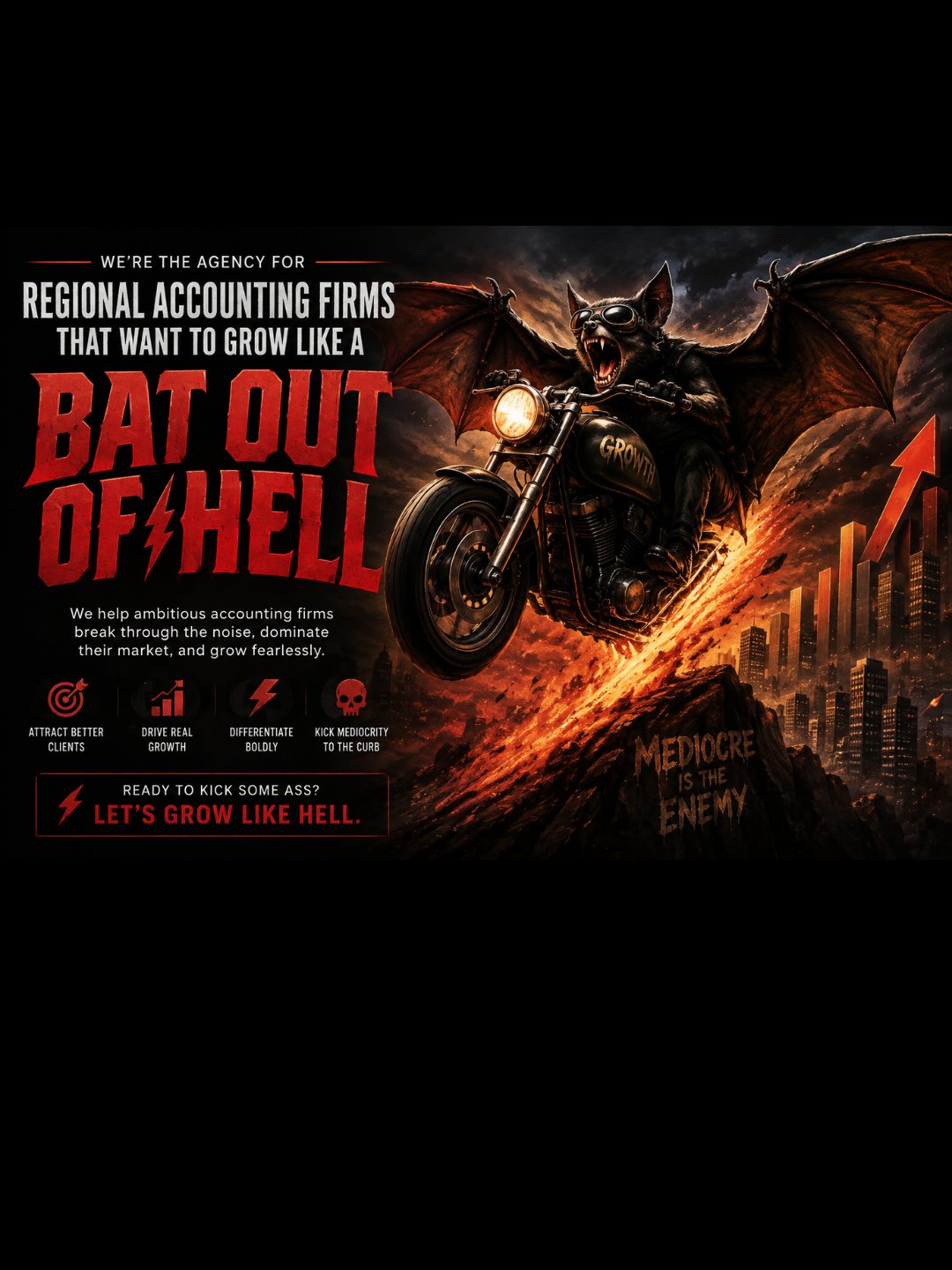 If your positioning doesn't make you think "Oh, shit...did I go too far?", friend, you've got a lot of work to do. Sure, positioning helps draw the right people to you, but it also scares the wrong ones away. Here's what happens when you positioning has all the spice of macaroni & cheese: Visitor 1: "Wow, I wonder what they do? It's hard to tell..." Visitor 2: "They don't mention any companies that I've ever heard of...they must work with small businesses just like me." Visitor 3: "I should probably request a quote on their website - that seems like a good way to. find out if they can help me." YOUR CRM: Full of broke people who don't know what you do. When you add a little Carolina Reaper to the recipe: Visitor 1: "Wow - they work with regional accounting firms that want to grow like a "Bat Out Of Hell! That's awesome - Bat Out of Hell is MY favorite Meatloaf album. And my accounting firm is ready to kick some ass." Visitor 2: "Jane, I know that these guys are "award winning" but I'm not sure that "Bat Out of Hell" is the right idea to support our new Dayton office. Can you find two other agencies that are, um, "rocking fewer tattoos"? Did I say that right, Jane?" Visitor 3: "OMFG, I wish they helped goth-inspired flower shops...but next time I talk to our accountant Spike, I am going to INSIST that he call them right now." Your CRM: 1 hot lead. 1 bad fit client that didn't waste your time (yay!). 1 referral waiting on Spike to close out the month end books for Angsty Agatha's House of Dramatic & Dark Floral Joy. See the difference?
 -
Most agency proposals are a built backwards. They start with process overview, team bios, a BS award from Clutch from 2020 & logos you hope the prospect will recognize. That's stupid - they are just squawking about themselves Open with description of their situation, their actual goals, the exact language they used to describe the pain... and they'll think holy shit, they actually got it. Clients hire the agency that made them feel understood. Your POV and insight closes deals, your "proprietary process" or "platinum platform partner" are just decorations. Lean into they stuff that matters to your client... THEM Start your next proposal by talking about them and see what happens.
-
AI makes hard shit faster. It does not make hard shit unnecessary. So many agency founders (and their teams) pump out metric tons of AI slop. Tt's showing up in their client work too... You've seen the ads, images and emails that scream "THIS IS AI SLOP!" You know that they focused on "faster" rather than BETTER. Great positioning, a discovery process that builds trust, the insight that makes a prospect say "Thank gawd I found you !!!" and great marketing execution all existed before AI. It was just really, really hard to do well, so most agencies didn't do itwell. And because marketers do, in fact, ruin everything - they've decided that more, shittier work is better than less, higher-quality work. That is bro-marketer "MUST SCALE" BS amplified by ChatGPT (or Claude - or whatever you love the best) AI as a force-multiplier is only true if there's something worth multiplying. More manure coming out of the chute doesn't make you a better marketer...it makes you a shit spreader. You still have to create revenue, trust, and real acceleration for your clients. AI didn't change that - it just made it easier to indulge your worst instincts. Take the time and CREATE the work that needs to be created to move your client's needle. Once you can do that reliably, THEN use AI to amplify, multiply & any other -ply you want...but if you indulge AI slop, you are going to be rolling around in the sty like all the other lazy little piggies.
-
AI is a management problem. Definitely not an existential threat. A management problem. Every few years there's a new thing that's going to kill everything. The internet was going to kill print. WYSIWYG editors were going to kill developers. Machine learning was going to make everything simple. None of that happened the way the hype said it would. And yet here we are, agencies losing their minds again, asking the same panicked questions they always ask when something new shows up. Do I need to rebuild everything? Do I need to hire someone who understands this? Am I already behind? Those are the wrong questions. The agencies that are going to actually benefit from AI are the ones who already know what they do, who they do it for, why they're different, and how they create impact. For those agencies, AI is a force multiplier. It makes the stuff they already understand how to do faster, more complete, more scalable. For everyone else? AI is just going to help you produce more of the wrong stuff, faster, at a lower cost per unit of mediocrity. You don't have a technology problem. You have a management problem. You need to know what you are trying to accomplish before you can point any tool at it and expect results. The agencies that skipped the work on positioning, on sales process, on understanding what actually creates impact for their clients... pointing an agent at that mess doesn't fix it. It just automates the confusion.
-
 Here's what you want to hear from your prospects: "I found you because you do X for Y". There's so many agencies that can't even say "WE DO X FOR Y" without it being really flabby. WTF do I mean by "flabby"? Flabby: We do paid social for ecommerce. → That's flabby because "paid social" means a bunch of things to a bunch of people. Ecommerce applies equally well to Amazon as it does to the dropshipping bro in Bali. How do I make this "non-flabby"? Well, we start with WHO you want to talk to...and it's got to be pretty specific: → VP of Marketing for ecommerce brand - FLABBY → VP of Marketing for ecommerce brand between $10mm & $50mm in revenue - LESS FLABBY → VP of Marketing for DTC ecommerce brand between $10mm & $50mm in revenue in the beauty space - LESS LESS FLABBY → VP of Marketing for DTC ecommerce brand between $10mm & $50mm in revenue in the beauty space with a subscription play - FIRM Now that you know WHO, now we can define X & Y: Y= Beauty brands that want to break the $50mm revenue plateau. X= We do UGC, Influencer & Brand video ads on Meta & TikTok to maximize subscription growth while keeping CPA in the 1st transaction profitable zone. A non-flabby "We do X for Y": We create & manage UCG, Influencer & Brand advertising on Meta & TikTok to help DTC beauty brands that want to break the $50mm revenue plateau. A really non-flabby "we do X for Y without Z": We create & manage subscription-focused UCG, Influencer & Brand ads on video-first social channels to help DTC beauty brands break the $50mm revenue wall without sacrificing 1st transaction profitability. DemandOS was built specifically for this. If you want to figure out what you actually stand for and say it in a way that makes the right people raise their hand, hit me up.
 -
Your proposal probably sucks. And it's not a proposal problem. Most agency founders treat proposals like the big moment. They spend hours on the deck, agonize over pricing presentation, fiddle with the scope language. And then they email it into a void and wonder why the prospect ghosts. The proposal isn't the problem. The conversation before it is. Three rules. Break any one of them and you are probably cooked. Rule 1: Don't agree to write a proposal until you know three things. What the prospect is actually trying to accomplish. How big a deal they think this problem is. How they make decisions. If you don't know all three, you aren't writing a proposal, you are writing a wish list of stuff you want to get paid for. Nobody buys a wish list. Rule 2: Never just send the proposal. Winning proposals get presented. If you email it without a scheduled walkthrough, you are handing your prospect a document full of things they can misread, misinterpret, and use to talk themselves out of it. Get the meeting first. Walk through it live. Every time. Rule 3: Nothing in your proposal should be a surprise. Every line, every number, every scope item should be confirming something you already talked about together. If your prospect reads your proposal and sees something they didn't expect, you didn't do enough discovery. Full stop. Surprises don't close deals, they open debates. If your proposals aren't closing, don't rewrite the proposal. Go back and look at the conversation that happened before it. That's where you lost it.
-
Wrong-fit clients are a positioning problem, not a discovery problem. Agency founders who are drowning in bad-fit clients want to fix their qualification questions, tighten their discovery process, build a better intake form. All of that is treating the symptom. You invited those clients. Your website did it. Your LinkedIn did it. Your "data-driven, ROI-focused, extension of your team" copy opened the door and said, come on in, everybody. When you write safe, broad, offend-nobody positioning because you are terrified of scaring someone away, you don't scare anyone away. Including all the wrong people. The agencies I see with the cleanest pipelines are the ones who said something real, something specific, something that made a certain kind of prospect go oh thank gawd I found them and made everyone else go yeah, that's not for me. Both of those outcomes are wins. Your messaging is supposed to do the qualification work before anyone picks up the phone. If it isn't doing that, your discovery call is going to be a rescue operation, not a conversation. Stop fixing your sales process. Fix what you're saying about yourself first.
-
Your proposal is really a test of how well you listen. Most agency founders treat it like a highlight reel. Process. Team. An award from 2022. Three logos you might recognize. The prospect opens that document and immediately knows you weren't paying attention on the call. Every proposal that leads with your credentials is just the Generous Professor showing up in PDF form. You are so eager to prove you are smart, so desperate to demonstrate that you can do the work, that you forgot to show them that you actually heard them. The proposal is where you prove whether you passed the listening test or failed it. Lead with your methodology and you've written a proposal about you. Open with a crisp, accurate description of their situation, their actual goals, the specific thing keeping them up at night that they mentioned in minute 22 of your call... and they'll think holy shit, they actually got it. Clients hire the agency that made them feel understood, not the one with the most impressive deck. Your POV closes deals. Your process is just the container. And your POV only lands when it's aimed directly at their problem, not broadcast at the room. Start the next proposal with their words, not yours. See what happens.
-
YOUR CASE STUDIES ARE MAKING YOU THE HERO. That's why they don't work. Most agency case studies read like a memoir. Back when we started with this client, the world was dark... we worked incredibly hard on 17,000 things... and eventually, the client made money. Nobody cares. Seriously. Nobody. The prospect reading your case study doesn't give a shit how busy you were or how complex the engagement was. They care about one thing: Do I see myself in this story, and does it end somewhere I want to go? Most case studies commit a capital crime: They turn you into the hero. Your process, your methodology, your team, your awards, your thinking. All of it. Front and center. The client? Somewhere in the back, like an NPC. Flip it. The client is the hero. You are the vehicle. The framework is dead simple: 1. Before. 2. After. 3. Your agency in the middle. That's the whole thing. They had this blocker, you removed it, here's what changed. BTW - case studies age like milk. The tactics you used 18 months ago might be completely irrelevant today. So stop trying to make them beautiful, permanent, design-award-worthy artifacts. Make them fast, disposable, and effective. A prospect who self-identifies in 30 seconds and wants to talk to you is worth a thousand people who looked at your hero images and said "Wow." The goal of a case study is singular: Move someone from audience to prospect. That's it. Result up front, client as hero, you in the middle. Done.
-
Case studies don't close deals. They never did. They were never supposed to. The agencies I see plastering case studies all over their websites and proposals are using them as a sales engine, and that's not what they are. A case study is a trust signal for someone who is already in motion, already curious, already halfway convinced. It's the thing that keeps a warm prospect from backing out, not the thing that makes a cold one lean in. The reason agencies over-rely on them is the same reason they say "data-driven" and "ROI-focused" and all that other boring-as-shit safe language. They are terrified of saying something real. Case studies feel like proof. You did the work, here are the numbers, nobody can argue with it. Except that a prospect who doesn't already believe you can do something different for them isn't going to be convinced by a trophy case. They are going to look at your results and think, cool, you did that for them. What does that have to do with me? The agencies that actually move people from audience to prospect do it with POV, not proof. They say something that makes a marketer or a brand think, holy shit, that's exactly how I've been thinking about this and I didn't know anyone else saw it that way. That's the moment someone goes from scrolling past you to booking a call. If your case studies are the most prominent thing in your content and your proposals, ask yourself what you are actually afraid to say out loud. Because whatever that is, that's probably the thing that would actually move someone.
-
So many of us sound like this when we start talking to prospects and clients. Don't wrap yourself in mystery....just explain what you do (and the impact it has) in such a way your prospect or referral partners can say: GOT IT. Getting biz is hard enough...don't make it harder.
-
Organic search used to be the big equalizer where unknown brands could compete with household brands. Cold outreach used to be a big equalizer where an unknown brand could compete with an industry leader. You might say that AI visibility is an equalizer today (but it isn't, really. It tends to reward those things that are highly visible and highly cited) Huge industries have started to take advantage of these "equalizers". So many businesses think that "If I just get attention through these "equalizers", my business will become as good as those bigger businesses I am chasing. " I've got some bad news for you - attention only creates opportunity. You still have to deliver great value, relationship-focused thinking (not transactional), and be rock solid-regular before you can really compete with industry leaders. Before you focus on chasing opportunity at scale. Make sure your business is ready to take advantage of it. (Lotsa folks get that twisted...)
-
 YOUR ICP IS A HYPOTHESIS The ICP you wrote down six months ago is a snapshot of what your best clients looked like six months ago. The market moved while your ICP stayed frozen (and not the cool Princess Elsa kind) That gap is is what makes you think WTF is happening?!?! Many agency owners treat their ICP as a one and done. You write it, you put it in the GTM deck, you hand it to the sales resource, & boom - handled! But the actual humans you are trying to sell to are reading stuff, reacting to competitors, getting spooked by news cycles, shifting budgets, and changing. Here's my take on creating a Live ICP. SIGNAL 1: What your best prospects are posting. Read the LinkedIn feeds of your 10 best-fit prospects every week. What are they worried about? What are they excited about? What questions are they asking publicly? That's your ICP telling you what it needs right now, in real time. SIGNAL 2: What's shifting on your discovery calls. If you are paying attention to your calls (and if you aren't, that's a different problem...), you'll notice when objections change. When a new hesitation shows up three calls in a row, that's not a coincidence. Something in the market shifted and your ICP needs to reflect it. SIGNAL 3: What your competitors are doing and saying. If their messaging shifts, either they know something you don't or they are all wrong together. Worth finding out which. SIGNAL 4: What your existing clients are reacting to. Your current clients are the living version of your ICP. When they start asking about something new, or freaking out about something that wasn't on their radar 90 days ago, your ICP just updated itself. Write it down. SIGNAL 5: What you are saying publicly and who responds. Your content is a filter. The people who engage, share, and DM you after a post are self-identifying. If the wrong people keep showing up, your messaging is attracting the wrong ICP. If the right people keep showing up, you found a signal worth amplifying. The goal isn't to rewrite your ICP all the freaking time, but you need to treat your ICP as a hypothesis you are always testing against live market behavior. And when the data changes, so does your ICP. If your pipeline has felt weird lately, take that static ICP and make it alive.
 -
A great agency ICP is like a John Singer Sargent portrait. (I'll add a link in the comments if you don't know who he is...) Richly detailed, accurate & evocative, but it's static. Your target market is more like Everything Everywhere All At Once. (The 2022 Best Picture winner - I'll add a link, too) Constantly switching context, just trying to make sense of everything & likely overwhelmed. Your agency positioning is the thing that bridges the gap between still life & chaotic jumpcuts. It takes the facts from the still life portraits and contextualizes what's causing the confusion - and let's your overwhelmed market know that you hold the keys to calm & clarity.
-
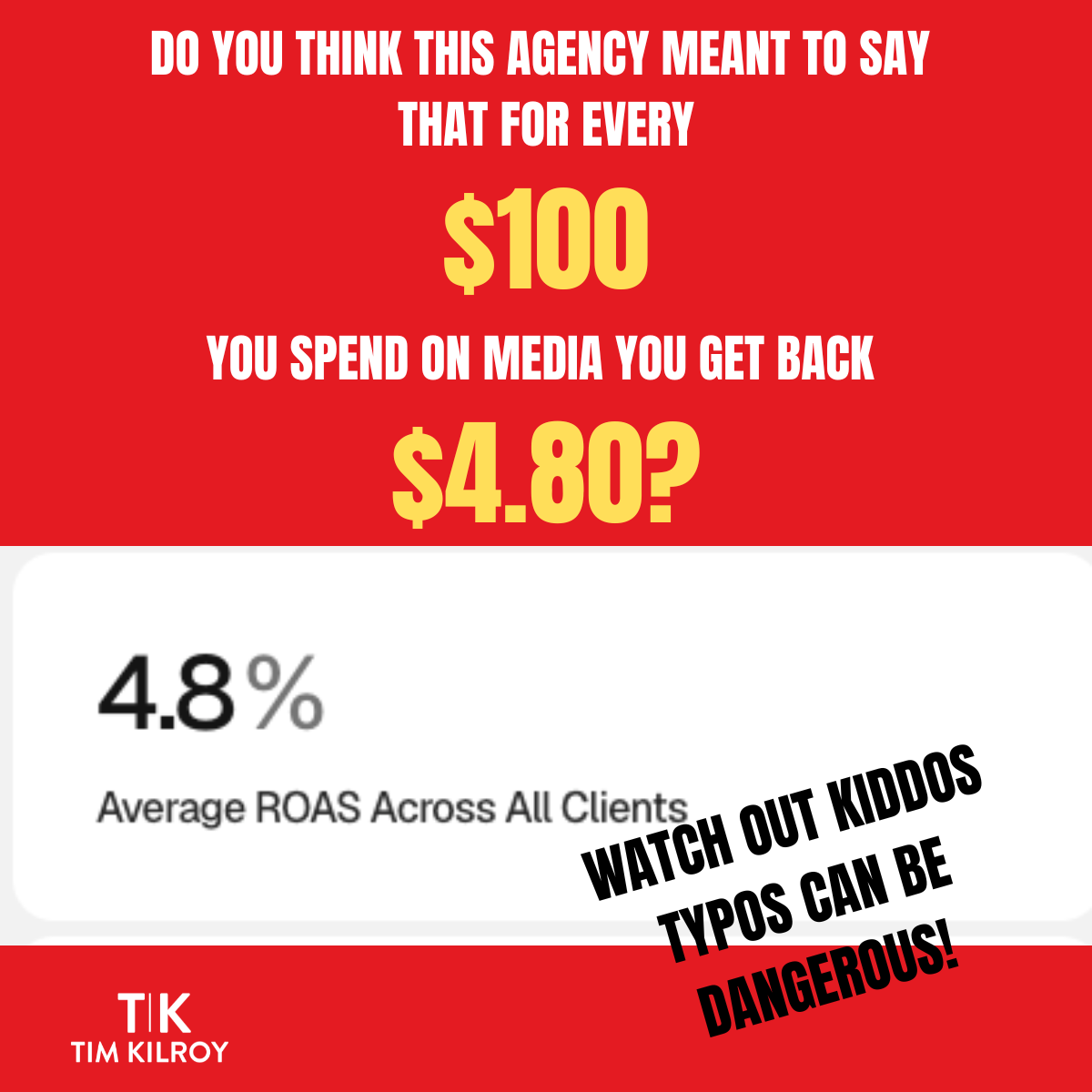 Watch out kiddos - typos on your home page are DANGEROUS
 -
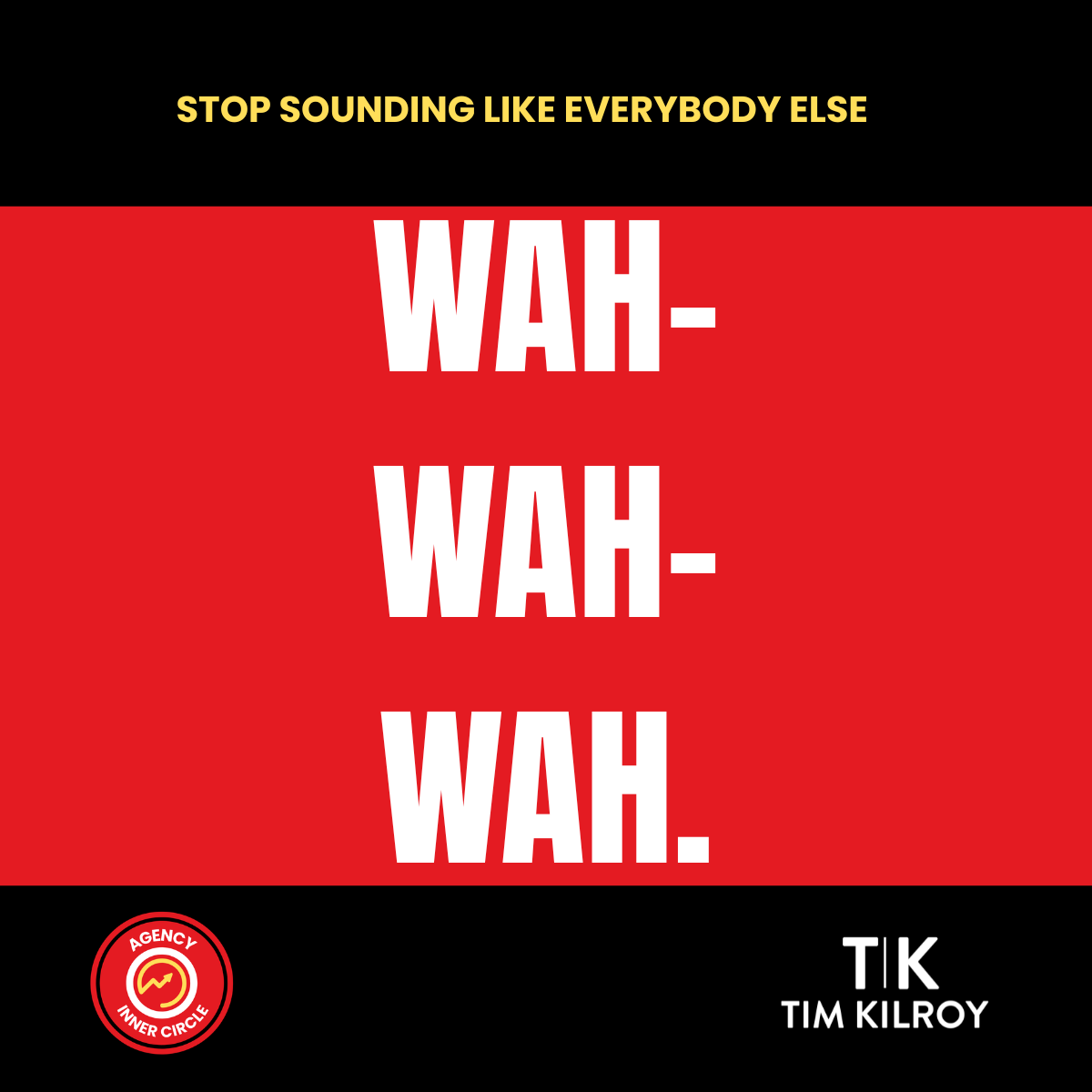 DOES YOUR AGENCY WEBSITE SOUND LIKE A CHARLIE BROWN ADULT? We fill our websites with words like "data-driven", "ROI-focused", and "customer-obsessed". Since every agency does that, those words and others like "extension of your team" just start to sound like the adults in Charlie Brown: WAH-WAH-WAH. So I built the WAH WAH DETECTOR. Just drop in your website, and my digital alter ego will run out and tell you all these places on your home page that you are saying "wah wah wah". It's free, it takes about 39 seconds, and hopefully you'll learn something. Get Your WAH WAH score here: https://app.timkilroy.com/wah-wah
 -
 Here is the easiest agency website positioning tip ever - I call it THE DOORMAN. Like any good doorman, if somebody belongs in your building, that doorman is going to welcome them within two seconds. If they don't belong in the building, that doorman is going to let them know that they should move along in two seconds. Does your website pass the doorman test? Do I know if your site is for me or not in the first two seconds?
 -
 Everybody says to agency owners that the need to hire for sales So people go out and hire a hotshot. 90 days later no leads, pipeline is full of shit & no revenue So of course, you are gonna point the finger at the new hire, but you do have to remember that when you are pointing the finger somewhere else, they are pointing back at you. Before you hire a sales resource, you have got to have a way to give them all the context of the company. - What do you sell? - What do you do? - Who's good for you? - Who's bad for you? - What are the great stories you have? - What are the things we want to avoid? You've also got to show them what the right expectations are. - If they are expected to develop leads on their own, how many? - What's a good close rate? - What's a bad close rate? - What resources do they have to close those leads? - How is pricing determined? All of this stuff they don't know anything about when they start, even if they've been doing it for years. They don't know anything about your company and what you want to accomplish, so it's your job as the CEO to figure all that shit out before you even think about hiring a sales resource. Check out my "Ready to Hire A BD Resource" assessment - link in bio
 -
You know what's so hard? Everybody says to agency owners, when they get somewhere over $1,000,000 in sales, that it's time to hire a sales resource. So people go out and hire some sort of person who's got experience with sales, and they throw them in the deep end. Fast forward 90 days & there's not a new lead, the pipeline is full of bullshit, and there's no new revenue. So of course, you are gonna point the finger at the new higher, but you do have to remember that when you are pointing the finger somewhere else, they are pointing back at you. Before you hire a sales resource, you have got to have a way to give them all the context of the company. - What do you sell? - What do you do? - Who's good for you? - Who's bad for you? - What are the great stories you have? - What are the things we want to avoid? You've also got to show them what the right expectations are. - If they are expected to develop leads on their own, how many? - What's a good close rate? - What's a bad close rate? - What resources do they have to close those leads? - How is pricing determined? All of this stuff they don't know anything when they start, even if they've been doing it for years. They don't know anything about your company and what you want to accomplish, so it's your job as the CEO to figure all that shit out before you even think about hiring a sales resource. Check out my "Ready to Hire A BD Resource" assessment - link in comments.
-
Agencies think that clients pay for the deliverables in the SOW. They don't. They pay for the impact on their business. There are two parts of the agency machine that create impact - POV & PRODUCTION. Agencies have doubled down on PRODUCTION as the thing that drives impact. AI & automation have made PRODUCTION cheaper/faster & some prospects have started to ask about "AI discounts". Here's the straight up truth: It's your POV that drives impact - your thinking, creativity, experience, insight & love make amazing results. An agency that is great at PRODUCTION vs an agency that is good at PRODUCTION might only change the impact by 5 or 10%. But an agency that is great at POV vs an agency that is good at POV might generate 10x or 100x impact. You've got to make your POV, valuable, defensible & real - it's your value.
-
𝗪𝗵𝘆 𝗺𝘆 𝟐𝟎𝟎𝟗 𝗹𝗼𝘀𝘁 𝗱𝗲𝗮𝗹 𝗽𝗼𝘀𝘁-𝗺𝗼𝗿𝘁𝗲𝗺 𝗶𝗻𝘀𝗶𝗴𝗵𝘁 𝗶𝘀 𝘀𝘁𝗶𝗹𝗹 𝗮 𝗯𝗮𝗻𝗴𝗲𝗿. Way back in 2009, my agency had just been acquired & I was doing a post-mortem on a lost paid search opportunity at the new agency. 𝗜 𝘀𝗮𝗶𝗱 𝘁𝗵𝗮𝘁 𝘄𝗲 𝘀𝗵𝗼𝘂𝗹𝗱 𝗰𝗵𝗮𝗿𝗴𝗲 𝗳𝗼𝗿 𝘄𝗵𝗮𝘁 𝘄𝗲 𝗸𝗻𝗼𝘄 𝗿𝗮𝘁𝗵𝗲𝗿 𝘁𝗵𝗮𝗻 𝘄𝗵𝗮𝘁 𝘄𝗲 𝗱𝗼. We lost out to an inferior agency because the prospect couldn't reconcile % of ad spend pricing with their goals. They thought we would push them to spend more rather than focus on efficiency. (That it wasn't true, but whatevs.) Plus, that pricing made us so susceptible to being undercut by someone else - if we were charging 9%, a marketer might choose somebody of similar skill who is willing to charge 8%. AI, automation & platform changes makes it imperative that you focus on your thinking because the incremental value of delivery is rapidly declining. Clients are now sometimes asking for an AI discount because it doesn't take as many fingers on the keyboard to execute campaigns anymore. 𝗛𝗘𝗥𝗘'𝗦 𝗧𝗛𝗘 𝗕𝗔𝗭𝗜𝗟𝗟𝗜𝗢𝗡 𝗗𝗢𝗟𝗟𝗔𝗥 𝗤𝗨𝗘𝗦𝗧𝗜𝗢𝗡: 𝗪𝗵𝗮𝘁 𝗺𝗮𝗸𝗲𝘀 𝘆𝗼𝘂 𝗯𝗲𝘁𝘁𝗲𝗿, 𝗺𝗼𝗿𝗲 𝗲𝗳𝗳𝗲𝗰𝘁𝗶𝘃𝗲, 𝗺𝗼𝗿𝗲 𝗶𝗻𝘀𝗶𝗴𝗵𝘁𝗳𝘂𝗹 𝗮𝗻𝗱 𝗯𝗲𝘁𝘁𝗲𝗿 𝗳𝗼𝗿 𝗮𝗻𝘆 𝗽𝗮𝗿𝘁𝗶𝗰𝘂𝗹𝗮𝗿 𝗽𝗿𝗼𝘀𝗽𝗲𝗰𝘁? It's a really hard question to answer, but start with what you know, how you think, what you know is important, & how that connects to each prospect & client's landscape. Marketers and brands don't buy better results - they buy different results. The only way that you can convince them that you can deliver different results is that you better fucking be different. Can you show how your agency is different and will lead that brand or marketer to a fucking different outcome? Spend some cycles on that.
-
YOU WANNA KNOW WHAT GRINDS MY GEARS? It's when agencies sell "better". You know - better results, better UX, better speed, whatever. The average agency will do an audit & politely shit on the previous work... and with faux humility & a sticky coating of swag, will say "We can do better!" (I've made that pitch and received that pitch a shit ton of times. ) But here's the thing - marketers and brands don't want to fucking buy "better". They want to buy "different". If they were mostly happy with things & want a little tweak, they wouldn't be talking to you. Why the fuck are you selling them optimization & BS "best-practices"? They don't need that shit. Here's what they need: 1. How your point of view changes their future. 2. How your thinking makes them grow in a way they can't figure out on their own. 3. How what you do makes the rest of their business better. If you are selling to a giant corporation that does hundreds of billions of dollars in revenue, a 2% reduction in CPA might actually make a huge difference - but very few of us are selling to those people. Marketers & brands are looking for a trajectory-altering difference. "Better" isn't gonna take a new brand and make it a mass market darling, it's not going to take the #5 SaaS in a vertical and make it a serious challenger to the incumbent. You can't give them different if you aren't willing to be different. Lean hard into whatever the fuck makes you, you. Stop playing small - the brands and marketers you serve aren't going to survive with small & incremental. Stop selling little shit & start selling the stuff that only you can make happen.